Author: Hu Ping
December 10, 2025

Fifteen Years Ago Today: Today is Liu Xiaobo Day—A Side Note from the Nobel Peace Prize Ceremony on December 10, 2010
On December 10, 2010, the Nobel Peace Prize ceremony was held at the city hall in Oslo, the capital of Norway. The annual Nobel Peace Prize ceremony is already a global sensation, and this year is especially extraordinary. A Western journalist said: “Thanks to the Chinese government’s relentless efforts, Liu Xiaobo’s news dominates all mainstream international media channels.” “I can say without exaggeration: December 10, 2010, is Liu Xiaobo Day.
Theaward ceremony was solemn, grand, sacred, and deeply moving. The most touching moment was when the Chairman of the Nobel Committee placed the Nobel Prize certificate on the chair reserved for Liu Xiaobo, stood up, and applauded for a long time to pay tribute to Liu Xiaobo, who is still imprisoned in Jinzhou, China. I’m not someone who gets emotionally easily moved. At that moment, tears welled up in my eyes.
Previously, Liu Xiaobo’s wife, Liu Xia, told us that if she couldn’t attend the awards ceremony, she should give her a thank-you speech on her behalf. But after that, we never received any information about her again. Yang Jianli, who was responsible for liaising with the Norwegian Nobel Committee, suggested that at the award ceremony, I would deliver the thank-you speech on behalf of Liu Xia, or I could read Liu Xiaobo’s final statement in Chinese. However, the Norwegian Nobel Committee insisted that if anyone spoke on stage representing Liu Xiaobo or Liu Xia, it must be legally authorized, and since we only had online conversation records, our suggestion was not adopted.
It istruly a great regret that Chinese voices were missing from the first award ceremony for Chinese people in a hundred years. So we decided that on the night before the awards ceremony, at the reception on the evening of December 9th, I would go up and say a few words on behalf of Liu Xia. Since we do not have a speech written by Liu Xia herself, nor one authorized by Liu Xia and approved by someone else, I can only express my thanks on her behalf: thank you to the Norwegian Nobel Committee, thank you to those who nominated and supported you, and thank all the distinguished guests attending the award ceremony. Your support for Liu Xiaobo not only expresses your concern for him, but also for all prisoners of conscience in China, as well as concerns for human rights issues in China and world peace.
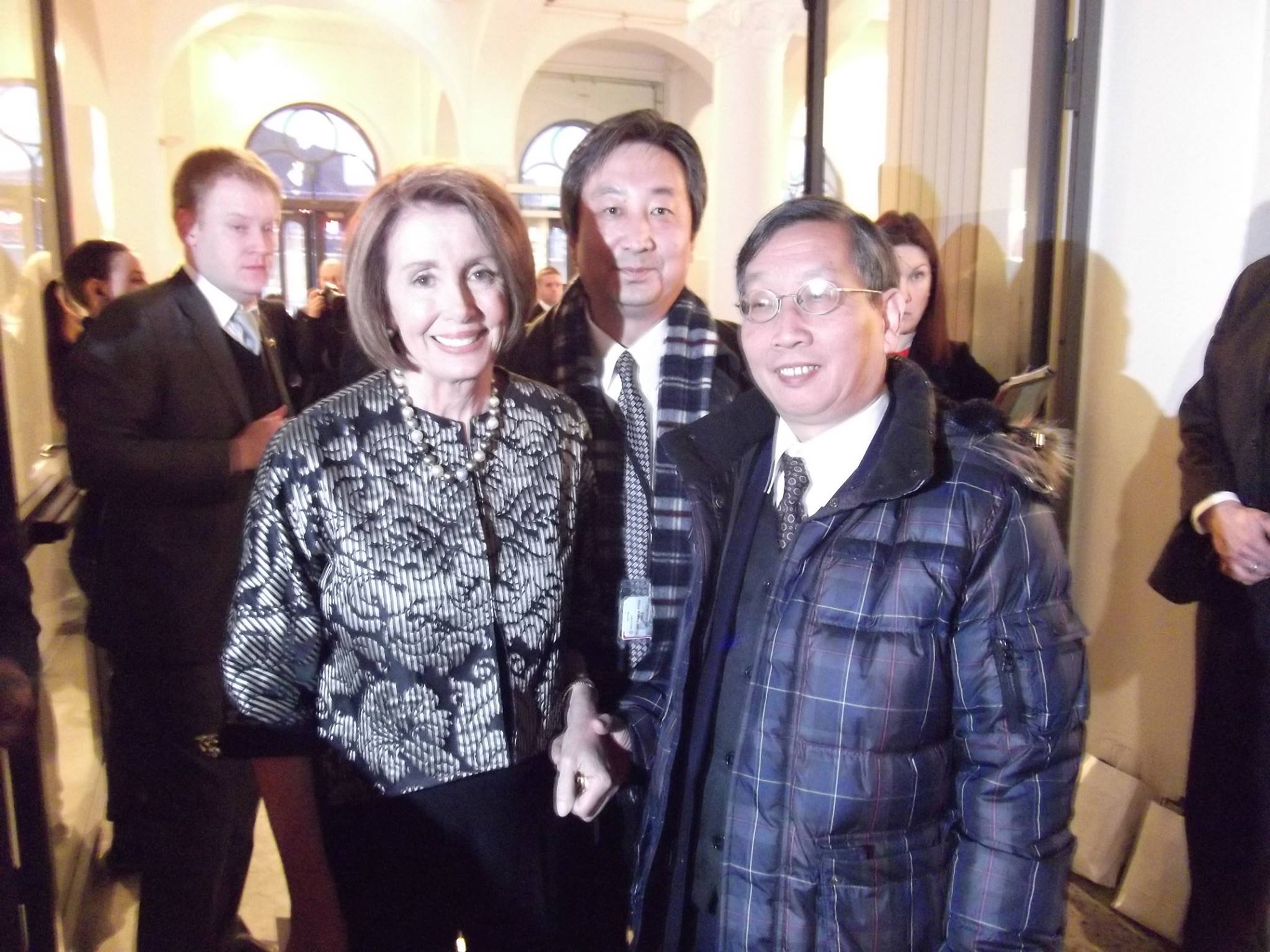
At the awards ceremony, I was seated in the front row, right next to U.S. Congressional Speaker Nancy Pelosi. Pelosi is a senior member of Congress who, since 1989, has remained steadfast in her concern and support for human rights in China for 21 years. I told her, ‘You are our best friend.’
At this awards ceremony, I met Mr. Adam Michnik, with whom I had long been close friends. Miczynik is one of the most renowned contemporary Polish intellectuals, having served as an advisor to the Solidarity Union and is the soul of Poland’s democratic movement. As early as 1988, I translated a long article introducing him from The New York Times Magazine into Chinese and published it in China Spring magazine; In 1998, I published a lengthy article in the magazine “Beijing Spring” that gave a systematic review of Michnick. In July this year, Michnick visited Beijing and held talks with dozens of liberal scholars and rights activists from across the country. This time, when Liu Xiaobo won the Nobel Prize and several of our friends discussed with Liu Xia which international guests to invite to the ceremony, I strongly recommended Michimnick. This meeting was naturally very pleasant. At the banquet, I sat with Michnick. I agreed to strengthen our contact in the future. I believe that with Michnick’s experience and wisdom, he will surely provide many profound ideas and valuable suggestions for China’s democratization.
Rebiya was also invited to attend the awards ceremony. Some dissenters disagreed with inviting Rebia, fearing it would give the CCP an excuse to claim that the pro-democracy movement supports Xinjiang independence. I had already suggested inviting Rebia. I think inviting Rebiya was absolutely right and absolutely necessary. Indeed, some Uyghurs do have independence tendencies, but to a large extent, their independence is forced out by the Communist Party. Since we all hope that in a future democratic China, Uyghurs will voluntarily choose to be with us, then from now on, we should fully express our sense of compatriotism to them. If even we refuse to invite them out of consideration for suspicion, wouldn’t that make them trust us Han people even less? Wouldn’t that push them toward “independence”?
Rebiya gladly accepted our invitation. She told reporters interviewed: She hopes that after Liu Xiaobo receives the Peace Prize, China will change its attitude toward ethnic minorities; She was moved by Charter 08 and was willing to sign it. Rebiya also said she believes Uyghurs’ views on Charter 08 should be similar to hers, and if Uyghurs had the right to sign the charter, she would be willing to sign on their behalf. However, Uyghurs currently do not have this right in China. Now, due to the oppression of the Chinese Communist Party, it is difficult to truly hear the voices of the Uyghurs. Another Uyghur attending the Oslo awards, Alim Seytoff, an old friend of ours, has previously attended several seminars hosted by Beijing Spring. He happily said to me, “Congratulations to Liu Xiaobo on winning the Nobel Prize. Without the Communist Party, there would be New China. ”
Representatives of Tibetan in exile also attended the award ceremony in Oslo. On the same day, Tibetans held a rally in New York to commemorate the 21st anniversary of the Dalai Lama’s Nobel Peace Prize and to celebrate Liu Xiaobo’s 2010 Nobel Peace Prize. Many pro-democracy activists in the New York area were invited to attend this Tibetan gathering. I believe that Liu Xiaobo’s Nobel Prize is a great boost to mutual understanding and respect among Han people, Tibetans, Uyghurs, and other ethnic minorities, and also greatly advances our future efforts to build a democratic federation of China.
People often compare this ceremony to the 1935 German journalist Ossitsky’s victory. Actually, there are quite a few differences between these two approaches. The 1935 award ceremony sparked significant controversy within the Norwegian Nobel Committee, with two members opposing the award and even resigning in anger. The King and Queen of Norway refused to attend the ceremony. Liu Xiaobo’s award was unanimously approved by all five members of the committee, and the King and Queen attended all three events (award ceremony, banquet, and concert). At the banquet, after finishing the meal, everyone went to the living room, and the king and queen also came to the living room. Several Chinese dissidents approached the king to speak and take photos.
Undoubtedly, this year’s Peace Prize is the most important in the more than a century of Nobel Peace Prize history. The pressure it has placed on the CCP authorities is unprecedented in the 21 years since June Fourth; Moreover, the CCP authorities’ response was unprecedentedly severe. Yes, China is rising, but the CCP authorities controlling China are a regime extremely hostile to universal values such as human rights and democracy. Here, I want to emphasize once again that the next ten years will be extremely critical for China and also for humanity. If, in the next decade, China fails to embark on the broad path of freedom and democracy, not only China but the entire world will inevitably face a tremendous disaster. This means we must not wait helplessly but must rise up to resist. Waiting for history to change an authoritarian regime is merely a way to delay resistance and avoid risk, requiring another generation to fight and take risks; And as time passes, the struggle will likely become more difficult, the risks will likely be greater, and victory will likely come more arduously and bitterly.
As the awards ceremony ends and the crowd disperses, we should and must make it a new starting point—a new starting point for mobilizing the Chinese people and the international community to fight for the early realization of human rights and democracy in China.



Source: Hu Ping’s Facebook